Is Solana working?
Data reporting
RPC health
ok
status
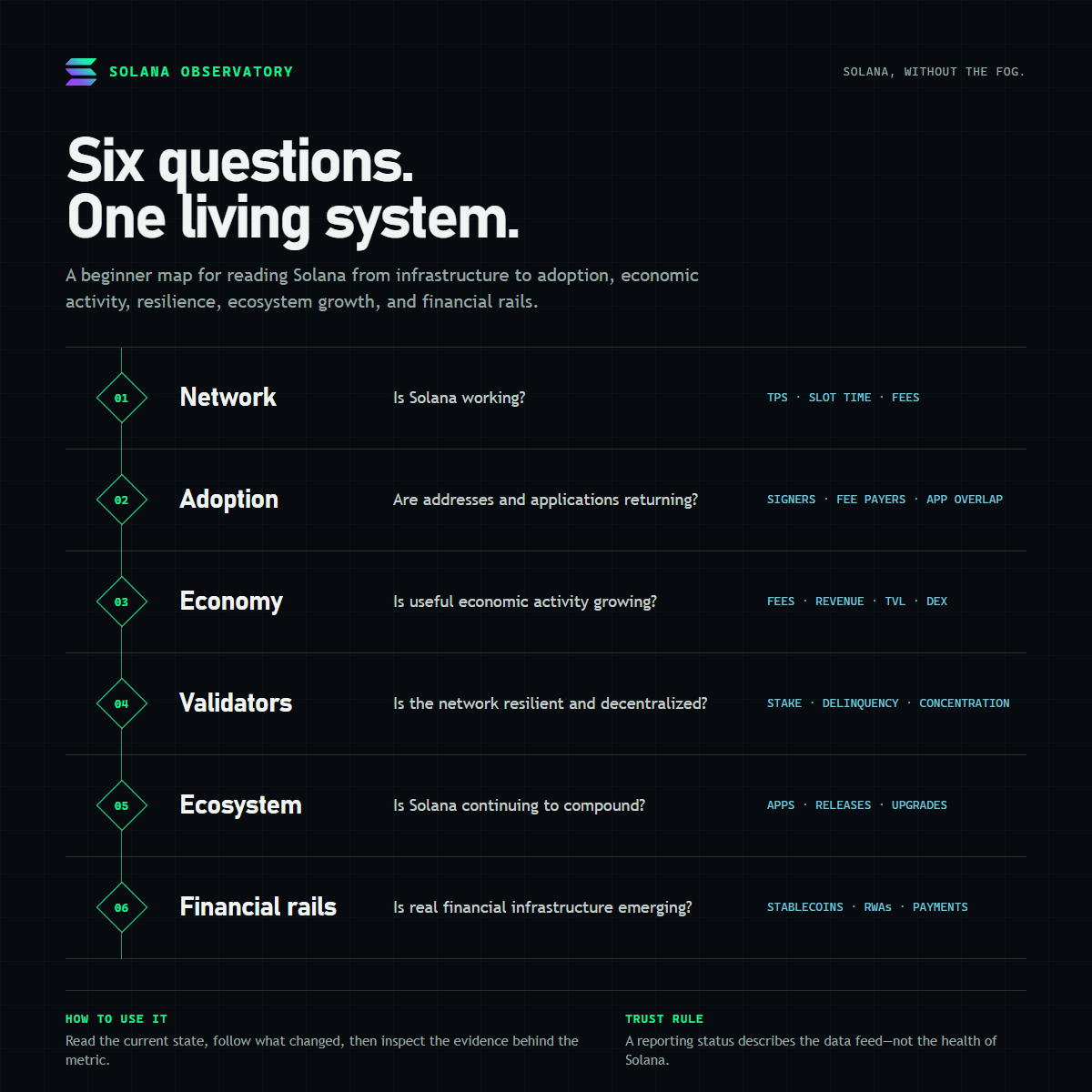
Six connected questions reveal whether Solana is working, attracting durable use, producing economic value, staying resilient, compounding its ecosystem, and becoming financial infrastructure. Wallets and transactions are measurements—not people.
This is an evidence map, not a score. Use it to find the question that changed, then inspect the measurement before deciding what it means.
Six questions. One living system. Choose the layer you want to understand.
Is Solana working?
Live network capacity, timing, and selected RPC health.
What this measures: Current block height reported by the selected RPC node.
Exact value: 417,336,022 block
Why it matters: Block height is a second progress marker that helps detect a stalled or lagging data source.
What could fool you: This is network progress, not a measure of user adoption.
See the evidence: Solana JSON-RPC / getBlockHeight
Collected: 2026-08-14T19:15:56.850092Z
Confidence: high
What this measures: Latest slot reported by the selected public RPC node.
Exact value: 439,284,706 slot
Why it matters: A rising slot confirms that this observer sees the chain continuing to advance.
What could fool you: Different RPC nodes can be a few slots apart.
See the evidence: Solana JSON-RPC / getSlot
Collected: 2026-08-14T19:15:56.850092Z
Confidence: high
What this measures: Share of the current epoch's slots already completed.
Exact value: 86.27 percent
Why it matters: Epoch progress provides timing context for validator rewards, stake activation, and network operations.
What could fool you: Epoch progress describes validator timing, not economic growth.
See the evidence: Solana JSON-RPC / getEpochInfo
Collected: 2026-08-14T19:15:56.850092Z
Confidence: high
What this measures: Non-vote transactions in the latest RPC performance sample divided by sample seconds.
Exact value: 1,955.22 transactions/second
Why it matters: This is the closest live RPC measure of application and user transaction throughput.
What could fool you: Non-vote transactions can still include bots and automated programs.
See the evidence: Solana JSON-RPC / getRecentPerformanceSamples
Collected: 2026-08-14T19:15:56.850092Z
Confidence: high
What this measures: Latest non-vote TPS relative to the median of earlier RPC performance samples.
Exact value: -9.54 percent
Why it matters: It detects short-run throughput drops or spikes without calling them good or bad.
What could fool you: The RPC sample window is short and non-vote transactions can include automation.
See the evidence: Solana JSON-RPC / getRecentPerformanceSamples
Collected: 2026-08-14T19:15:56.850092Z
Confidence: medium
What this measures: Latest performance sample duration divided by slots produced.
Exact value: 0.41 seconds
Why it matters: Slot time indicates how quickly the chain is advancing in the most recent sample.
What could fool you: This is a short recent estimate and can move between samples.
See the evidence: Solana JSON-RPC / getRecentPerformanceSamples
Collected: 2026-08-14T19:15:56.850092Z
Confidence: high
What this measures: Latest estimated slot time relative to the median of earlier RPC performance samples.
Exact value: -1.36 percent
Why it matters: It detects a short-run slowdown in chain progression.
What could fool you: This compares a bounded set of recent samples from one RPC endpoint.
See the evidence: Solana JSON-RPC / getRecentPerformanceSamples
Collected: 2026-08-14T19:15:56.850092Z
Confidence: medium
What this measures: All transactions in the latest RPC performance sample divided by sample seconds.
Exact value: 3,636.40 transactions/second
Why it matters: Total throughput shows network load, but must be separated from user activity because it includes validator votes.
What could fool you: Includes validator votes, so it is not the same as user activity.
See the evidence: Solana JSON-RPC / getRecentPerformanceSamples
Collected: 2026-08-14T19:15:56.850092Z
Confidence: high
What this measures: Health response from the selected public RPC node.
Exact value: ok status
Why it matters: It is the first check that the dashboard's live network data path is responding normally.
What could fool you: This checks one public RPC endpoint, not every validator.
See the evidence: Solana JSON-RPC / getHealth
Collected: 2026-08-14T19:15:56.850092Z
Confidence: high
Are people and applications returning?
Wallet activity and retention with identity limitations kept visible.
What this measures: Jupiter Swap signer addresses that were also the successful transaction fee payer on the same UTC day.
Exact value: 14,316 wallet addresses
Why it matters: The overlap reveals how often the visible application signer also pays the transaction fee.
What could fool you: This is an address intersection, not a count of people; sponsored or relayed transactions can fall outside it. Automatic refresh note: The saved Dune result is preserved but needs a fresh query execution.
See the evidence: Dune / jupiter_solana.aggregator_swaps + solana.transactions / daily_jupiter_swap_signers.sql
Collected: 2026-08-13T19:27:46.924528Z
Confidence: high
What this measures: Distinct tx_signer addresses on intended swaps recorded by Dune's curated Jupiter aggregator table during the latest complete UTC day.
Exact value: 14,316 wallet addresses
Why it matters: It shows the scale of intended swap activity through one of Solana's major application routes.
What could fool you: Wallet addresses are not people, and this measures Jupiter Swap signers rather than users of a particular wallet app. Automatic refresh note: The saved Dune result is preserved but needs a fresh query execution.
See the evidence: Dune / jupiter_solana.aggregator_swaps + solana.transactions / daily_jupiter_swap_signers.sql
Collected: 2026-08-13T19:27:46.924528Z
Confidence: high
What this measures: Distinct primary signer (fee payer) addresses on successful non-vote Solana transactions during the latest complete UTC day.
Exact value: 2,040,011 wallet addresses
Why it matters: Fee payers approximate how many distinct addresses initiated successful activity and paid for execution.
What could fool you: Wallet addresses are not people: one person or bot can control many addresses, and relayers may pay fees for others. Automatic refresh note: The saved Dune result is preserved but needs a fresh query execution.
See the evidence: Dune / solana.transactions / daily_unique_fee_payers.sql
Collected: 2026-08-13T19:27:46.924528Z
Confidence: high
What this measures: Distinct signer addresses on successful non-vote Solana transactions during the latest complete UTC day.
Exact value: 3,720,700 wallet addresses
Why it matters: Successful signers capture a broader set of participating addresses than fee payers alone.
What could fool you: Wallet addresses are not people: one person or bot can control many addresses, and one transaction may require several signers. Automatic refresh note: The saved Dune result is preserved but needs a fresh query execution.
See the evidence: Dune / solana.transactions.signers / daily_unique_successful_signers.sql
Collected: 2026-08-13T19:27:46.924528Z
Confidence: high
What this measures: Share of the day's Jupiter Swap signer addresses also seen at least once during the preceding seven complete UTC days.
Exact value: 49.85 percent
Why it matters: Return rate distinguishes repeat use from one-time address activity.
What could fool you: Returning addresses are not necessarily returning people; bots and one person using several wallets remain included. Automatic refresh note: The saved Dune result is preserved but needs a fresh query execution.
See the evidence: Dune / jupiter_solana.aggregator_swaps + solana.transactions / daily_jupiter_swap_signers.sql
Collected: 2026-08-13T19:27:46.924528Z
Confidence: high
Is useful economic activity growing?
Market, liquidity, fees, and onchain economic activity.
What this measures: One-signature base fee plus the median recent prioritization fee reported by the selected RPC node.
Exact value: 5,000.00 lamports
Why it matters: It provides a bounded, user-scale fee benchmark alongside aggregate chain fees.
What could fool you: This is an estimate for a one-signature transaction using one RPC node's recent cache, not the median fee of every executed transaction.
See the evidence: Solana JSON-RPC / getRecentPrioritizationFees + protocol base fee
Collected: 2026-08-14T19:15:56.850092Z
Confidence: medium
What this measures: CoinGecko's 24-hour percentage change for SOL/USD.
Exact value: -1.74 percent
Why it matters: It supplies a bounded price-move signal for anomaly review.
What could fool you: A price move does not explain network health or user adoption.
See the evidence: CoinGecko / simple/price?include_24hr_change=true
Collected: 2026-08-14T19:15:58.167937Z
Confidence: high
What this measures: CoinGecko's aggregated market price for one SOL in USD.
Exact value: 74.71 USD
Why it matters: Price supplies market context for SOL-denominated capital and validator economics.
What could fool you: Market price is volatile context, not evidence that network or application usage is growing.
See the evidence: CoinGecko / simple/price?ids=solana
Collected: 2026-08-14T19:15:58.167937Z
Confidence: high
What this measures: Fees users paid covered Solana applications on the latest complete UTC day, excluding gas, stablecoin issuers, and liquid staking.
Exact value: 8,663,231.06 USD
Why it matters: App fees show what users paid applications for covered services.
What could fool you: Adapter coverage can change, and fees paid are not money retained by applications.
See the evidence: DeFiLlama / overview/fees/solana?dataType=dailyAppFees
Collected: 2026-08-14T19:15:58.167937Z
Confidence: high
What this measures: The portion of covered Solana application fees retained by protocols on the latest complete UTC day.
Exact value: 4,158,946.95 USD
Why it matters: App revenue shows captured value under provider definitions.
What could fool you: This is not profit; incentives, token emissions, and operating costs are separate.
See the evidence: DeFiLlama / overview/fees/solana?dataType=dailyAppRevenue
Collected: 2026-08-14T19:15:58.167937Z
Confidence: high
What this measures: Base and priority transaction fees paid to the Solana network on the latest complete UTC day, as indexed by DeFiLlama.
Exact value: 709,826.00 USD
Why it matters: Chain fees show demand for scarce transaction execution.
What could fool you: Higher fees can reflect demand, congestion, speculation, or MEV. DeFiLlama's adapter estimates base fees from transaction count although Solana's protocol fee is charged per signature.
See the evidence: DeFiLlama / summary/fees/solana?dataType=dailyFees
Collected: 2026-08-14T19:15:58.167937Z
Confidence: high
What this measures: USD value locked in Solana DeFi protocols tracked by DeFiLlama on the latest complete UTC day.
Exact value: 4,823,175,760.00 USD
Why it matters: TVL shows how much capital is deposited in tracked Solana DeFi protocols.
What could fool you: TVL depends on protocol coverage and methodology and can double-count economic exposure through composable assets.
See the evidence: DeFiLlama / v2/historicalChainTvl/Solana
Collected: 2026-08-14T19:15:58.167937Z
Confidence: high
What this measures: Aggregate Solana spot DEX volume tracked by DeFiLlama on the latest complete UTC day.
Exact value: 1,942,768,289.23 USD
Why it matters: DEX volume shows how much spot exchange activity occurred across tracked Solana venues.
What could fool you: Routing can touch several pools, and provider adapter and deduplication coverage determine the reported total.
See the evidence: DeFiLlama / overview/dexs/Solana?dataType=dailyVolume
Collected: 2026-08-14T19:15:58.167937Z
Confidence: high
What this measures: Solana chain fees plus gross Jito MEV tips tracked by DeFiLlama for the latest complete UTC day.
Exact value: 837,418.00 USD
Why it matters: REV estimates direct economic value paid for blockspace and transaction ordering.
What could fool you: REV is not GDP, profit, or app revenue; private or non-Jito MEV may be outside coverage. Jito component: https://api.llama.fi/summary/fees/jito-mev-tips?dataType=dailyFees
See the evidence: DeFiLlama / dailyFees(Solana) + dailyFees(jito-mev-tips)
Collected: 2026-08-14T19:15:58.167937Z
Confidence: high
Is the network resilient and decentralized?
Validator participation and, in later slices, stake distribution.
What this measures: Activated stake assigned to currently active vote accounts.
Exact value: 434,497,764.07 SOL
Why it matters: It shows how much voting power is currently participating.
What could fool you: Vote accounts are not necessarily distinct operators or organizations.
See the evidence: Solana JSON-RPC / getVoteAccounts
Collected: 2026-08-14T19:15:56.850092Z
Confidence: high
What this measures: Vote accounts currently classified as active by the RPC response.
Exact value: 688 validators
Why it matters: Active vote accounts show how many validators are currently participating, before considering stake concentration.
What could fool you: A validator count does not describe how evenly stake is distributed.
See the evidence: Solana JSON-RPC / getVoteAccounts
Collected: 2026-08-14T19:15:56.850092Z
Confidence: high
What this measures: Delinquent activated stake as a share of all activated stake in this response.
Exact value: 0.04 percent
Why it matters: Stake share is more meaningful than a raw delinquent-validator count.
What could fool you: One RPC snapshot can change quickly as validators recover or fall behind.
See the evidence: Solana JSON-RPC / getVoteAccounts
Collected: 2026-08-14T19:15:56.850092Z
Confidence: high
What this measures: Activated stake assigned to vote accounts currently classified as delinquent.
Exact value: 172,151.54 SOL
Why it matters: It sizes the voting power currently failing to participate normally.
What could fool you: Delinquency can be temporary and does not imply malicious behavior.
See the evidence: Solana JSON-RPC / getVoteAccounts
Collected: 2026-08-14T19:15:56.850092Z
Confidence: high
What this measures: Vote accounts currently classified as delinquent by the RPC response.
Exact value: 10 validators
Why it matters: Delinquency is an early operational signal that part of the validator set is falling behind.
What could fool you: Temporary delinquency can recover and is not automatically malicious behavior.
See the evidence: Solana JSON-RPC / getVoteAccounts
Collected: 2026-08-14T19:15:56.850092Z
Confidence: high
What this measures: Median advertised commission among active vote accounts with valid values.
Exact value: 5.00 percent
Why it matters: Commission affects how staking rewards are divided between validators and delegators.
What could fool you: The median does not include operating cost, MEV, or total validator profitability.
See the evidence: Solana JSON-RPC / getVoteAccounts
Collected: 2026-08-14T19:15:56.850092Z
Confidence: high
What this measures: Minimum largest vote accounts whose combined activated stake reaches one third.
Exact value: 18 vote accounts
Why it matters: A larger value means more vote accounts are required to reach consensus-blocking stake.
What could fool you: This is calculated by vote account, not verified independent operator.
See the evidence: Solana JSON-RPC / getVoteAccounts
Collected: 2026-08-14T19:15:56.850092Z
Confidence: high
What this measures: Share of activated stake assigned to the ten largest vote accounts.
Exact value: 24.44 percent
Why it matters: It exposes concentration hidden by the total validator count.
What could fool you: Vote accounts are not operators; one organization may control several accounts.
See the evidence: Solana JSON-RPC / getVoteAccounts
Collected: 2026-08-14T19:15:56.850092Z
Confidence: high
What this measures: Share of activated stake assigned to the twenty-five largest vote accounts.
Exact value: 40.16 percent
Why it matters: It provides a broader view of stake concentration beyond the largest validators.
What could fool you: Vote accounts are not operators and ownership identity is not inferred.
See the evidence: Solana JSON-RPC / getVoteAccounts
Collected: 2026-08-14T19:15:56.850092Z
Confidence: high
What this measures: Share of active stake on vote accounts whose latest epoch-credit record increased.
Exact value: 100.00 percent
Why it matters: It checks whether active voting power shows evidence of recent vote participation.
What could fool you: One credit record is a bounded participation check, not a full performance history.
See the evidence: Solana JSON-RPC / getVoteAccounts
Collected: 2026-08-14T19:15:56.850092Z
Confidence: high
Ranks are vote accounts, not operators; one organization may control multiple accounts and ownership is not inferred.
| Rank | Vote account | Stake (SOL) | Share | Commission | Status |
|---|---|---|---|---|---|
| 1 | CcaHc2L43ZWjwCHART3oZoJvHLAe9hzT2DJNUpBzoTN1 |
17,055,966.79 | 3.92% | 7.00% | current |
| 2 | he1iusunGwqrNtafDtLdhsUQDFvo13z9sUa36PauBtk |
15,972,698.76 | 3.67% | 0.00% | current |
| 3 | CatzoSMUkTRidT5DwBxAC2pEtnwMBTpkCepHkFgZDiqb |
12,477,807.81 | 2.87% | 5.00% | current |
| 4 | 3N7s9zXMZ4QqvHQR15t5GNHyqc89KduzMP7423eWiD5g |
12,363,210.43 | 2.84% | 0.00% | current |
| 5 | 26pV97Ce83ZQ6Kz9XT4td8tdoUFPTng8Fb8gPyc53dJx |
9,161,872.42 | 2.11% | 7.00% | current |
| 6 | 51JBzSTU5rAM8gLAVQKgp4WoZerQcSqWC7BitBzgUNAm |
8,981,436.52 | 2.07% | 10.00% | current |
| 7 | 8GbwASqdpw4dVcwbWUxbHXMrjyQx2aKkoBR5H1GJF8iD |
8,300,271.06 | 1.91% | 0.00% | current |
| 8 | 9QU2QSxhb24FUX3Tu2FpczXjpK3VYrvRudywSZaM29mF |
7,966,398.32 | 1.83% | 7.00% | current |
| 9 | CvSb7wdQAFpHuSpTYTJnX5SYH4hCfQ9VuGnqrKaKwycB |
7,372,731.34 | 1.70% | 5.00% | current |
| 10 | DumiCKHVqoCQKD8roLApzR5Fit8qGV5fVQsJV9sTZk4a |
6,581,887.05 | 1.51% | 0.00% | current |
Source: Solana JSON-RPC / getVoteAccounts · collected 2026-08-14T19:15:56.850092Z
Is Solana continuing to compound?
Selected upgrades, announcements, and application movements.
What this measures: Elapsed days since the newest non-draft, non-prerelease Agave release.
Exact value: 1.00 days
Why it matters: Release recency is one bounded sign of maintained core software.
What could fool you: A recent release is not automatically safe or widely adopted, and release age is not a developer-count metric.
See the evidence: Anza Agave GitHub releases / GitHub releases; latest stable tag v4.2.1
Collected: 2026-08-14T19:16:10.881149Z
Confidence: medium
What this measures: Non-draft, non-prerelease Agave releases published in the trailing 90 days.
Exact value: 11 releases
Why it matters: Release cadence shows whether core client work is shipping publicly.
What could fool you: Release count is not adoption, code quality, contributor count, or proof that validators upgraded.
See the evidence: Anza Agave GitHub releases / GitHub releases; stable releases; trailing 90 days
Collected: 2026-08-14T19:16:10.881149Z
Confidence: medium
What this measures: Current phase and expected activation window shown on Solana's official upgrade page.
Exact value: Under development · Q3 2026 official roadmap
Why it matters: It tracks the named consensus upgrade without implying that a roadmap date is guaranteed.
What could fool you: Roadmap dates can move; announced development is not mainnet activation.
See the evidence: Official Solana source / Alpenglow Phase 1 - Votor
Collected: 2026-08-14T19:16:12.945606Z
Confidence: high
What this measures: Elapsed days since the newest item in Solana's official RSS feed.
Exact value: 1.20 days
Why it matters: It keeps current ecosystem developments visible without treating social sentiment as fact.
What could fool you: This is one official editorial feed, not a complete view of community news or sentiment.
See the evidence: Official Solana source / RSS latest item: Solana Changelog: August 13, 2026
Collected: 2026-08-14T19:16:12.945606Z
Confidence: high
What this measures: Current status declared in the official SIMD-0525 proposal for staged shorter slots.
Exact value: Draft proposal status
Why it matters: It tracks a sponsor-named proposal that could materially change Solana latency.
What could fool you: A SIMD status is not proof that code is deployed or activated on mainnet.
See the evidence: Official Solana source / SIMD-0525 front matter
Collected: 2026-08-14T19:16:12.945606Z
Confidence: high
What this measures: Developers contributing to attributable open-source Solana repositories in a month.
Exact value: Not available developers
Why it matters: It would show the current size of the attributable builder base.
What could fool you: Source not connected: no dependable no-key live export and repository-attribution contract has been verified.
See the evidence: Electric Capital Developer Report / optional reproducible developer dataset
Collected: 2026-08-14T19:16:10.881149Z
Confidence: experimental
What this measures: Attributable Solana developers active across a defined prior and current period.
Exact value: Not available developers
Why it matters: Retention would separate durable building from one-time repository activity.
What could fool you: Source not connected: no dependable no-key live export and repository-attribution contract has been verified.
See the evidence: Electric Capital Developer Report / optional reproducible developer dataset
Collected: 2026-08-14T19:16:10.881149Z
Confidence: experimental
What this measures: Distinct DeFiLlama categories among positive-TVL protocol records that include Solana.
Exact value: 45 categories
Why it matters: Category breadth shows whether activity spans several use cases.
What could fool you: Provider category labels can change and do not measure usage, quality, or economic importance.
See the evidence: DeFiLlama / protocols; distinct category; Solana; tvl > 0
Collected: 2026-08-14T19:16:10.881149Z
Confidence: medium
What this measures: DeFiLlama protocol records that include Solana and currently report positive TVL.
Exact value: 386 protocols
Why it matters: It provides a reproducible lower-bound view of deployed DeFi breadth.
What could fool you: This is provider coverage, not all Solana apps, active users, developer retention, or product quality.
See the evidence: DeFiLlama / protocols; chains includes Solana; tvl > 0
Collected: 2026-08-14T19:16:10.881149Z
Confidence: medium
Is Solana becoming real financial infrastructure?
Tokenized assets, stablecoin settlement, payments, and liquidity.
What this measures: Value transferred for identifiable commerce or remittance, with a published attribution method and coverage boundary.
Exact value: Not available USD
Why it matters: Payments would show use of Solana as financial settlement rather than only trading infrastructure.
What could fool you: Raw stablecoin transfers are not payments: they can include trading, bots, rebalancing, and repeated movement.
See the evidence: No approved live source / deferred pending defensible payment attribution
Collected: 2026-08-14T19:15:58.167937Z
Confidence: experimental
What this measures: Circulating market value of tokenized real-world assets on Solana, excluding the stablecoin asset class.
Exact value: Not available USD
Why it matters: This would show adoption of tokenized treasuries, equities, credit, commodities, funds, and other off-chain claims.
What could fool you: Source not connected: dependable API access requires authentication. No historical article value is substituted.
See the evidence: RWA.xyz (optional adapter) / v4 assets aggregate; Solana; exclude Stablecoins
Collected: 2026-08-14T19:15:58.167937Z
Confidence: experimental
What this measures: USD value of circulating stablecoins on Solana across DeFiLlama's peg buckets on the latest complete UTC day.
Exact value: 16,080,626,457.00 USD
Why it matters: Stablecoin value shows the dollar-like liquidity available for trading, saving, and settlement on Solana.
What could fool you: Circulating stablecoin value is not payment volume or proof that every token is backed by cash.
See the evidence: DeFiLlama / stablecoincharts/Solana
Collected: 2026-08-14T19:15:58.167937Z
Confidence: high
Why now?
From a performance experiment to a test of global financial infrastructure. Facts and interpretation remain separate.
Verified historical factProof of History was conceived in 2017; Solana's genesis block launched Mainnet Beta on March 16, 2020.
Observatory interpretationThe original wager was that cheap, fast shared state could support applications at internet scale.
Solana: 8 Innovations ↗Verified historical factThe Solana Foundation reported rapid growth in DeFi, NFTs, validators, and projects during 2021; its historical counts do not include a reproducible methodology.
Observatory interpretationDemand arrived quickly, making precise definitions of users, projects, and capital essential.
Solana Foundation 2021 community update ↗Verified historical factSolana launched payment and mobile experiments while official incident reports documented consensus-impacting network halts.
Observatory interpretationThroughput means little without dependable execution, so reliability belongs beside adoption.
Solana Solstice 2022 ↗Verified historical factThe Foundation highlighted Helium's migration, state compression, Saga, DeFi recovery, and major commerce and infrastructure integrations.
Observatory interpretationThe recovery case rests on retained builders and widening utility, not token price alone.
Solana Foundation 2023 community review ↗Verified historical factFoundation and developer reports documented growth across stablecoins, payments, mobile, DePIN, institutions, and new developers.
Observatory interpretationSolana began looking less like one trading venue and more like a general financial and consumer platform.
State of Solana at Breakpoint 2024 ↗Verified historical factA Foundation network report cited nearly 16 months of uptime, multiple validator clients, substantial application revenue, and a voting-power Nakamoto coefficient of 20.
Observatory interpretationThe next test became resilience: diverse software, distributed stake, and sustainable operators.
Solana Network Health Report, June 2025 ↗Verified historical factFoundation ecosystem reports highlighted expanding stablecoin settlement and tokenized real-world assets; live values require their underlying datasets.
Observatory interpretationThe thesis now is convergence: crypto-native markets meeting payments, tokenized assets, and institutional distribution.
Solana Ecosystem Roundup, June 2026 ↗New to the observatory?
A short field guide to the dashboard, the network, and the project behind it.
Start with the six questions. Open a metric only when you want its definition, interpretive risk, or source. A reporting badge describes the data feed; it is not a verdict on Solana.
How to read this report without mistaking a useful metric for the whole truth.
Every metric retains its definition, source, collection time, confidence, and important limitation. Total TPS includes validator votes. Non-vote TPS can still include bots. Neither number equals “humans using Solana.”